

Lower Elementary
(1st – 3rd)
The Montessori Lower Elementary environment spans 1st to 3rd grades, for children aged 6 – 9.
The teacher-studio ratio in the Pre-Primary classrooms is 1:8 with three staff; this allows teachers the opportunity to provide individualized attention and to facilitate the children’s self-paced learning.
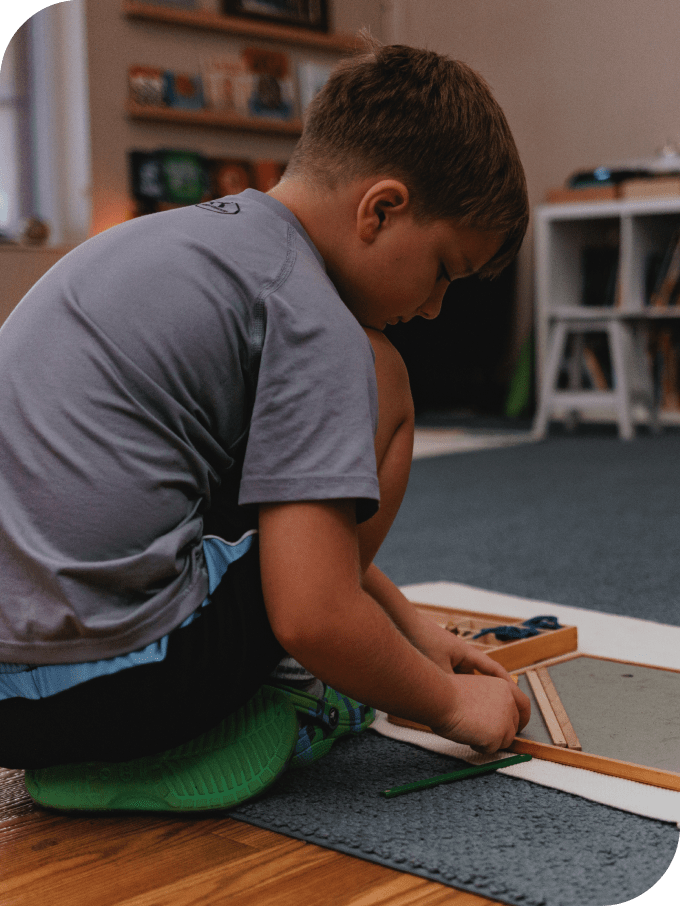
Children are encouraged to learn both in cooperation with each other and independently.
Developmental Notes
1st to 3rd Grade
Children during 1st to 3rd grade are actively social and begin to demonstrate an ability to think abstractly. Montessori education, at the lower elementary level, is designed to spark the imagination and to address the child’s need to interact with others.
Through observation, teachers outline individual plans for each child’s developmental level. A multi-age group, 6-9 years of age, provides a community of support. An elementary class, typically of 15-20 children, is child-directed with a certified Montessori teacher acting as guide.

The teacher’s task is not to talk, but to prepare and arrange a series of motives for cultural activity in a special environment made for the child.”
Maria Montessori
Classrooms
Classrooms at Central Montessori Academy are bright, warm and inviting spaces. They are filled with intriguing materials, fascinating models and colorful maps. The Montessori Materials provided in each classroom are tools that stimulate the child into logical thought and discovery.
The Lower Elementary classrooms feature:
- Plants, animals, natural light, and beautiful materials.
- Outdoor work and a discovery space with a garden area.
- Children have jobs and feel a sense of ownership within their environment.
- Children learn about making plans and setting priorities in their work through the use of planners.
- Students are self-motivated and enjoy the discovery and interactions that Montessori works provide
Curriculum
Without the ability to picture what is beyond the senses, a child could not grasp the great mysteries of our universe. All elementary education begins and flows from the lessons of history: how the universe was formed, how life formed on earth, how man developed, and how man met his fundamental human needs of communication through the development of math and language. These studies result in an awareness of our interdependence and an inner gratitude for life. Our children will become the future world peacemakers.
There are many important subject areas your child will learn about each year, including:
- Grammar
- Mechanics
- Math/Geometry
- Geography
- Physics
- Zoology
- Botany
Each year, your child will be introduced to the same elemental concept, but a new lesson will be given. This helps reinforce and build upon the previous concept—to expand into a new concept and understanding.
A Typical Day
- The classroom opens at 8:15 and school starts at 8:30. When the students come in, they put their belongings away and look at the schedule to see what they should do next (read, write in their journal, or start morning work). Each student fills in his or her individual work planners before morning meeting starts.
- 8:45 – The teacher will inform the students that it is time for morning meeting. During morning meeting, they go over the schedule of the day, lessons that will be given, and works that will be due that week. The teacher will review each student’s planner individually and ask the child what he or she is going to work on when morning meeting is over.
- 9:30 – Small group lessons are given. Meanwhile, other students outside the group lesson work on independent works on the floor or at their desk.
- 11:25 – Students clean up by organizing or putting away their works if completed. During this time, the children also do their jobs.
- 11:40 – The students have lunch and then go to recess.
- 12:15 – After recess, the children read quietly.
- 1:15 – Children continue working in the afternoon or participate in specials, which include: Spanish, Music, Gym, Art, and Reading, depending on the day’s schedule.
- During the afternoon, the teacher observes and works with individuals as needed.
- 3:25 – The children clean up once again: organizing their work, putting it away and doing their job. The children will get their mail and belongings ready for dismissal.
Your child’s Montessori journey starts with you.